Sunday, March 1, 2015

Excavation, by Wendy Ortiz


Ortiz presents us with the best kind of memoir: one that reads like fiction. I won't give anything away about the plot, but the story's characters are also presented to the reader in the best possible way. No one needs me to remind them that life is hardly ever one thing or another. In "Excavation" bad things happen, but no one in the book is painted as purely victim or purely villain.

The story begins with the author in middle school and Ortiz captures her young voice, the scenes, and the setting perfectly. One interesting structural choice: the sporadic inclusion of sections titled "Notes on Excavation" which explore the story from the pov of the author as an adult. Unsure at first as to how I felt about these sections, I decided this structure was a necessary, brilliant move on the author's part, one that interrupted the narrative so that readers are reminded of the fallout of the story-present.

Also, one of the truly amazing and beautiful things Ortiz has accomplished here is that she portrays a young girl's sexuality. Not since Alicia Erian's "Towelhead" have I read such an unflinching account of a young female's libido. Makes me wonder why this one aspect of life has been so off-limits.

In addition, "Excavation" does a good job reminding us how vulnerable we are. How when we are young, small and big acts of betrayal and neglect can wound us in a deep and long-lasting way. And how, as we work to heal these wounds, as they shift in our subconscious like the colored pieces in a kaleidoscope, our bodies/lives manifest the fallout.

"Excavation" is a triumph on so many levels. An important read for memoir lovers. An important read for everyone.

Wednesday, July 9, 2014

Two RSBRs on the subject of empathy: "My Friend Dahmer," by Derk Backderf and "The Empathy Exams," by Leslie Jamison.

Ridiculously Short Book Reviews on "My Friend Dahmer" and "The Empathy Exams."
Here's a question I've been pondering: How far can empathy be stretched? Is it possible to put yourself in someone else's shoes no matter who that person is, no matter what acts of evil that person has committed? Is there always a path available to us through which we can understand another's experience? Backderf does this in his stunning graphic novel. The prose and pictures work together perfectly to convey what Backderf witnessed in and knew about Dahmer, his classmate: Dahmer's wildy dysfunctional set of parents, his childhood marked by neglect of such a magnitude it could have unmoored the best of us, and the terrible, cruel, evil behavior that escalated until the day he was caught. "The Empathy Exams" is a collection of essays by Leslie Jamison that I haven't yet finished. But it's a remarkable read. She deftly inserts facts about her own life into bigger world-stories which allows her to examine and parse complex issues. Isn't this why any of us write? To understand ourselves and the world?
Both books, athletics for the mind. Ways to stretch our empathy. Isn't this the basic job description of a human? Two books, so different, both gems.

RSBR: The Infinite Tides, by Christian Kiefer

Ridiculously Short Book Review: "The Infinite Tides," by Christian Kiefer
Pam Houston, author of "Contents May Have Shifted," and one of my favorite essays, "Corn Maze," came to Butler two years ago. At dinner, I sat across from her, dazed. Earlier that day I watched one of my kids undergo a medical procedure. And because this is about one of my kids that's all I can say, except that I was reeling from watching the procedure and from its import. Even when I'm not in the midst of going through family drama I'm introverted, and super-shy around authors I admire. But I managed to ask Ms. Houston about what she was reading. And did she ever give me some great recs. One was "The Infinite Tides," a story about an astronaut whose family undergoes tragedy while he's in orbit. The prose is EXQUISITE, and the story idea, the way the author set up his protagonist so he experiences grief under the starkest, most isolated circumstances, is brilliant. I loved this novel and can't wait to see what Kiefer writes next.

RSBR: Bringing in Finn, by Sara Connell

Ridiculously Short Book Review: Bringing in Finn, by Sara Connell
Sara and her clan made it onto Oprah: Sara's 61-year-old mother carried Sara and her husband's baby. Before it was born. In her uterus. It's a fascinating story, compelling despite that it's not a great work of literature. I still wonder about the structure, telling the story from a tragedy that happened mid-story and then working backward through time before moving forward. But if you've got a mother who is able and willing to carry and bear your child, how could you not write the book? Like I said, I'm a sucker for pregnancy drama stories. Do they call that preg-lit?

RSBR: Half Baked: The Story of My Nerves, My Newborn, and How We Both Learned to Breath, by Alexa Stevenson

I have been missing you, blog. Missing the chance to document -- and therefore remember -- the books I've read. Missing the chance to write about them, to process. But I no longer have the time to write essays about each of my book reading experiences, so I'm trying something new: RSBK, Ridiculously Short Book Reviews. A few sentences to gesture toward the plot and any thoughts I have. We'll see if this works. It won't be as satisfying for me -- or for any readers, if any of you remain. But I think I might be on to something. Let's give it a shot, shall we?

Half Baked. LOVE this memoir, and I love Ms. Stevenson, although I've never met her. I'm a sucker for dramatic pregnancy tales, and I can't help but feel a kinship with other anxiety-disordereds. Anyway, when I write about my anxiety I'm inclined to do so with humor -- because the premise of anxiety, of being afraid of something that hasn't yet happened and indeed may never even happen, is funny. The author has a few problems with infertility and then, with the help of medical science, becomes pregnant with twins. There's a lot of sadness and uncertainty and indeed, tragedy, but the author tells her story with tenderness and humor. Ms. Stevenson is very funny. And my humor bar is set high. I won't give any more away because it's a great read. Btw this author began as a blogger, I believe. Find her at flotsamblog.com

Friday, February 28, 2014

You Came Back, by Christopher Coake


At a certain spot in the audiobook of Christopher Coake's “You Came Back,” the plot took a very unexpected turn, and I almost drove into a snowbank. Oh my God! I can't believe this happened! I thought, but my heart wasn't pounding because I'd nearly plunged the minivan into a wall of snow--I was thinking about the story.

I loved, loved, loved Coake's characters. Mark Fife is trying to move on after his young son dies, and his wife, Chloe, divorces him. Allison is Mark's new fiance. These people were as deeply textured and complex as off-the-page, nonfictional humans. “You Came Back” is a tender, heartbreaking, gripping story about families and the terrible and wonderful and strange things that happen to them. To us. It's about about loss and love. It's about grief, and how we cope.

It's about hope.

When I began Coake's novel I knew nothing about its plot. So the reading—I mean listening—experience brimmed with the frisson that comes with discovering new terrain. That's why I'm not giving any more information about the story, dear reader, because my hope is that you, like me, will be swept away.

Christopher Coake's novel “You Came Back,” is a gift, my friends. Read it on the beach (if only!). Read it in bed. Read it for your book club. Just read it.

Thursday, February 6, 2014

What's at stake? "The Middlesteins," by Jami Attenberg.


The two-hour drive on snow covered I-70 was worth it. The Lions of Winter conference at Eastern Illinois University featured authors I love, so despite my panic at driving on slush I persevered. (I won't even mention how my attendance itself pushed against my introversion, how I freeze whenever I'm around the event's planner, the much admired Roxane Gay.)

Two workshops in particular caught my eye. One was led by Alissa Nutting (subject of the previous post), and the other by Jami Attenberg. I'd read Jami's fourth novel, “The Middlesteins,” months ago. The Middlesteins are a family much like my own neurotic, Jewish mishpocha—except the Middlesteins exist only on the page, so I can appreciate their endearing antics without enduring angst.

Matriarch Edie Middlestein has an obsession. She seeks solace in steak dinners and steaming bowls of cashew chicken. She shovels piles of potato salad into her mouth as her adult children plan their kids' bnai mitzvahs, complete with chocolate fountains. Edie's food addiction drives her husband, Richard, out of the house and the story soars. “The Middlesteins” is a novel, but it reads so true. Attenberg doesn't spare the fictional family—they cry, they bloat, they search for comfort—but she paints them with such empathy, I couldn't not adore them. “The Middlesteins” is a rare novel—simultaneously insightful and fun. Go read it. You won't be sorry.


Not That Kind of Steak.

“In a good story the guiding force is the stake,” said Attenberg in the workshop. “Always ask yourself: Do I care about what's at stake? Your story needs more than interesting characters.”

The author added that the stake, which can be about anything—money, friendship, love—should be revealed in the first 50 pages of a novel and has to be resolved by the end of the book. Also, a novel should have one big stake and lots of other smaller stakes weaving around it.

Bigger.

“The setting of a story can increase the stakes,” said Attenberg, who taught that the bigger the stake, the better the story. Some settings, like New York City, naturally amp up the stakes. “Instead of writing a scene in which your characters have a conversation in a park,” she said, “put them in an elevator. One with a stop.”

Better.

On character development: One good way to get to know a character is to kill off someone the character knows. How does the person react to the death? Another way to get to know a character is to send him/her on a simple task. Attenberg told us, “I like to send someone off to buy a pack of cigarettes.”

Jar of Secrets.

Attenberg's provocative prompt had my heart pounding. She passed out slips of paper onto which each of us was to write our deepest secret. She collected the slips, put them in a jar, and instructed us to take out a random slip and write a scene about it. On the slip I pulled my co-workshopper disclosed that she had punched her father during one of her parents' fights. (Or maybe the author of the secret was a guy. Who knows?) I admit to being slightly disappointed—I was hoping to pull a murder confession—but made do. Besides, hitting a parent who's already rumbling with your other parent doesn't seem so dark to me. But then again, who am I to judge someone else's shame? I have enough of my own. My deepest secret? I'm not telling.

Saturday, January 25, 2014

The Disturbing and Twisted World of Alissa Nutting

Back in May of 2012 I reviewed on this blog “Monsters,” a collection of monster stories and highlighted my favorite: Alissa Nutting's Daniel. I adored this riff on the ambivalence of motherhood which featured a mother who blames herself when her boy grows up and morphs into a monster with fangs. She remembers that as she breastfed him she was exhausted and overwhelmed. As he drained milk from her breasts she imagined he was draining blood from her slit wrists.


Speaking of overwhelmed mothers, I was one today. I tend to hyperventilate when driving on snow, but I managed to stay calm enough to motor over black ice and through white slush this morning to get to the Lions in Winter conference at Eastern Illinois University. I'll repeat: In Illinois.

Nutting was the first speaker.


Ms Nutting began her talk by confessing that she had suffered a serious bout of postpartum depression and attended a therapy group. The lab coated counselor in charge of her group pulled out a dry erase marker and wrote the word “Disease” on the white board. “I was bored, so I stared ahead and started to do Kegels.” She looked at the audience, a smile in her eyes and added, “You might be doing the same thing now.” Her counselor took the marker and drew a line through the word “Disease,” splitting it into “Dis” and “ease.” Nutting decided that this concept could inform her writing—a character's levels of ease and dis-ease defines his/her motivation.

Alissa Nutting spent a good amount of time sharing her thoughts about evil. She projected onto the wall a chart that divided evil into ten ascending levels, at its base is a killing done in self defense, and at the apex is a killing in which the murderer tortures his victims. “My interest is in individuals who kill one person at a time,” she said, straight-faced. “Mass murders are simply too big in scope for me to understand.”

I can't figure out a segue from “evil” to discount marketers—you'll have to make that leap on your own—but when Nutting spoke about the craft of writing and building her characters, she said she likes to take characters and imagine they are in a Kmart in order to make note of what the character notices and feels.

The talented Ms. Nutting not only gave an informative and entertaining talk, but her new novel, “Tampa,” distracted me while I navigated the icy roads.
“Tampa” is a story about sexual predation told from a different angle. It's thought provoking. It's salacious. It's disturbed. It's wonderful. So is Alissa Nutting.


Monday, September 30, 2013

Fiction: Dinner with Eugenides

I had dinner with Jeffrey Eugenides.

This is not fiction.

I'm working toward my MFA in Creative Writing at Butler and this semester I enrolled in a fiction workshop.

I struggle to write fiction—it's hard to make stuff up.

I'd been in class less than a month when Pulitzer Prize winning author Jeffrey Eugenides came to read.

At dinner I sat next to Jeffrey Eugenides and struggled to make small talk.

My balsamic chicken, roasted sweet potato and salad greens rested on the plate in front of me, but I was star-struck, unable to lift my fork. Had Jeffrey Eugenides been wearing cologne, I would have smelled it—he was that close. Classmates carried the conversation. Finally I spoke. “What do you think of the movie version of “Virgin Suicides”? and as the words left my mouth, a warmth bloomed across my cheeks.

Mr. Eugenides turned from the extroverts at our table and focused his gaze at me. “What did you think about it?” he asked.

I froze.

Was this a trick? I'd spent the earlier part of that day behind the closed blinds in my living room watching the movie. I loved it. But did Eugenides love it? Movie adaptations are famous for butchering novels. No doubt the author found many things wrong with the film adaptation of “The Virgin Suicides,” but I was probably too unstudied, too dense, to catch them. But he'd trapped me. It would have been impolite not to answer.

I took a breath. “I had the feeling that they tried to be as faithful as possible to your book. As I watched I couldn't help but picture the people making the movie taking your book in their hands and holding it lovingly.”

“What did you think?” I asked.

“I agree,” he said. I didn't know if he was being polite or truly agreeing with me. He said a few things about what it was like to have Hollywood turn your novel into a movie, but I was too preoccupied, thinking I'm having dinner with Jeffrey Eugenides to remember a single word.

I love his novels, but I was curious about his life.

I had read that the Pulitzer Prize winner was married and had a 15-year-old daughter, but something about the way he dressed—his attention to his appearance was obvious—gave me the impression he was available. My teenage daughters will attest to my fashion cluelessness, but I would have bet his loafers hailed from Italy. His not-quite-as-narrow-as-Russel-Brand's slacks seemed too stylish to have been pulled from a rack at Macy's. The author emanated lit-glam, something we don't see much of here in the Hoosier state. Google search “Jeffrey Eugenides” for images, (I did), and your screen will fill with professional portraits, his hair styled to look as if tousled by a gentle wind, his chin soul-patched. Dapper and fit, Eugenides looked like he'd made good use of his gym membership since his last publicity shots. (I later found out through the grapevine that he's going through a divorce.)

It wasn't until after he left town that I discovered evidence of this curious intersection of literary and style in “The Custom of the Country: Vogue Re-Creates Edith Wharton's Artistic Arcadia.” With text by Colm Toibin, and photography by Annie Leibovitz, this Vogue spread features Eugenides, Jonathan Safran Foer, and Hollywood notables. Check it out here and here. Intriguing still, his daughter, Georgia, appears in Teen Vogue, here.

Eugenides may have had lit-glam, but he was a good sport. Every time a camera was proffered by a fan, he posed. He obliged with an autograph every time.

At his reading Mr. Eugenides opened with a joke about his accommodations. Staying overnight in the guest quarters in Butler's Efroymson Center for Creative Writing house, he voiced concerns that the bed he was to sleep in had been occupied by other visiting writers. And then he joked that writers who followed him would probably worry about sleeping in a bed in which he had slept. Eugenides read a short story, one that has yet to be published, but lent itself to being read out loud.

After the reading, and at the next day's Q&A, he entertained questions about his three novels.

About “The Virgin Suicides”

The idea for the book came to him after he met a woman who had tried to commit suicide and all her sisters had, too. “'The Virgin Suicides' is driven by language, is all about mood. I wrote the book in one sitting over three years,” he joked. He spoke about that slippery concept of voice. “Once you get the voice of a book you can replay it, like music you can play each day.”

“Roth said that once he had to write 120 pages before coming up with a sentence that contained the DNA of the whole book.” The first and last lines of Eugenides' novels are famous for possessing just this quality. “When you find the voice of a novel it allows you to tell a story that's latent, one that's waiting to be created.”

About “Middlesex”

“'Middlesex' is a book driven by plot. With “Middlesex” I began with the idea of writing a short novel about an intersex person.” Here, the crowd laughed. “Middlesex” is one of my all-time favorite books, but at over 500 pages, it's a beast of a read. Eugenides had read “Herculine Barbin,” a book about a hermaphrodite by Foucault, but found it melodramatic and unsatisfying. Frustrated at not understanding such a person, Eugenides became interested in writing about an intersex character. “I didn't want my story centered around a mythical person. And I didn't want to write a fanciful story.” In order to figure out how to write a realistic story about an intersex character, Eugenides researched different conditions before deciding to write about a protagonist who had 5-alpha-reductase deficiency. “The gene that causes this condition is recessive, so I decided to write about three generations.”

Eugenides' hometown of Detroit figures in each of his novels, but is most prominent in “Middlesex.” The author said that although many tie Detroit's decline to the riots of '67, he sees those riots as the culmination of a downward spiral that began in the '30s and '40s when the car industry began to move out operations.

About Calliope Stefanides (Cal), the protagonist of “Middlesex,” Eugenides said, “I gave Cal the ability to go into the mind of other characters because I didn't want to splinter the emotional story between them. It's really Cal's story.”

He compared the raucous and winding plot of “Middlesex” to a Greek epic. “Desdemona and Lefty (Cal's grandparents) were the Greek Gods who ran over Cal's life. “Middlesex” is a mock epic. Being Greek is inherently funny. You begin with Greek gods and end with souvlaki.”

About “The Marriage Plot”

In his third novel, a story about a love triangle that takes place in the early '80s between Madeleine, Mitchell and Leonard, Eugenides said he went deep into each of the three main characters' minds. “This novel,” Eugenides said, “is completely character-driven.” At first he thought he could create these characters solely out of his imagination, but they were far from his experience. “This didn't work very well,” he said, so he started, little by little, drawing from people he knows. “It's difficult to nail a person on paper. Creating a character is the hardest thing a novelist does.”

“The Marriage Plot” is set in the same year Jeffrey Eugenides arrived at college. Like the book's characters, Eugenides also studied literary theory. “'This book can be read as a deconstruction of the traditional marriage plot, or of love stories.” Eugenides shared that when he started college as an aspiring writer, Roland Barthes had just declared “the death of the author.” “At the start, I was writing into the stiff wind of literature.”

“A loss of selfishness and ego comes through writing fiction. It allows you to find a voice that can get you outside your own ego. It improves one's character, leads to a more intense examination of your life. Writing fiction makes me feel alert and alive.”

I'm not making this up: After the reading Eugenides went out for drinks with some of my writing buddies. They claim they would have called me, but that they didn't have my cellphone number. “I'll get over it,” I said. Now that was fiction.

Sunday, August 4, 2013

A visit from Jennifer Egan

The petty, immature, myopic part of me flamed with jealousy when Jennifer Egan visited Butler last spring. Cheekbones like cliffs, delicate features, porcelain skin. Willowy figure. When I saw her I thought Cheryl Tiegs. But Egan has something Tiegs does not, that accessory that goes with everything, a PULITZER PRIZE. My god. Last year, Jhumpa Lahiri, another Pulitzer winner, spoke at Butler. But while Lahiri—an introvert—was private, some might say guarded, Ms. Egan, was breezy and casual. Jennifer Egan had about her an informality that caused my envy to instantly melt away.

After reading the first chapter of “A Visit From the Goon Squad,” Egan went on to share the genesis of that story. Years ago her wallet was stolen, and someone from the credit card company called to confirm the theft and verify her personal information. After Egan got off the phone, she realized she'd been had—the caller wasn't an employee of the credit card company, but the thief. Some time later Egan looked down at the floor of a public bathroom and spotted a purse and wallet. This sighting rekindled her curiosity about the person who stole her wallet, giving her the seed for a short story that became the first chapter of Goon Squad.

Egan said that this short story prompted ideas for more stories, and she began each new piece featuring one of the characters from the preceding story. And so the novel began, each chapter written in a different tone, employing different structures, techniques, and standing on its own. Egan said she didn't know what these stories would become or under what genre they might fall, but had an epiphany when she changed the headings in this collection of stories from Part One and Two to Part A and B. What she was writing was the literary equivalent of a concept album. Something about the collision of tones, styles and moods contributed to the story as a whole.

The day after her reading a handful of grad students, including moi, got to chat with Ms. Egan about all things literary over Bazbeaux pizza. Topics included her book club, her writing group, and her love of epic poetry. “Byron's 'Don Juan,'” she said, “is inspired and is the funniest adventure story you'll ever read.”

Egan participates in a writing group that began in '89. The members submitting work don't send it to the group to read ahead of time, but instead read their submissions aloud at the meeting. This, Egan said, has the added benefit of putting the critiquers on the spot—they can't fudge their responses. She said that if readers haven't examined a piece closely enough, they may concentrate on the less important parts of the text. (With this comment I remembered the many times I fell into that particular trap, giving my classmates' pieces short shrift, and I'm sure my face flashed bright pink.) Her group asks the question: Does the writing have a pulse? Egan admitted that it's a difficult process for her. Even though her animosity is short-lived, she hates it when people criticize her work. And even though it irks her when members of the group come up with solutions to problems in the text, it's useful because it makes her focus on those issues. “A good solution solves more than one problem,” she said. “And once in a while the solution is actually right.”

Egan genially answered questions about her writing process, and about writing in general.

How does she begin a story or novel? “With time and place,” she said. She starts with a “where,” an atmosphere, a sense of place to which she can attach a longing memory.

She writes her first drafts by hand without making any changes along the way. This keeps her in a “continuous present.” “Reading these first drafts is terrible,” she said, but she reads them to give herself a sense of what she has. Then she goes back and develops an extremely detailed outline of revisions. For her novel “The Keep,” her outline—single lined, 10-point font—was 80 pages long.

Egan spoke about voice, which she compared to the stock of a soup. When she wrote “The Keep,” she had been using the voice she used from her last book, which she finds is often the case. “That old voice scorned the new text,” she said. She kept writing, struggling to find “The Keep”'s true voice. Out of frustration she wrote in her notebook the phrase “I'm writing a book,” and it was when she reread this that she found the piece's voice and realized there was a first person narrator behind the third person narrator of the book.

Her writing advice? “Push everything to show as much as possible about the character. Every structural unit—every story, chapter, paragraph, even sentence—has to tell a story.”

Egan peppered our discussion with fun anecdotes. In a fascinating bit of literary trivia, she told us that the original manuscript of Proust's “In Search of Lost Time,” began not with the now iconic madeleine, but a “biscotte.” Who knew?

Butler's wide array of visiting writers is fabulous, and my goal is to learn everything I can from each and every one. The authors always bring their A-game, although when a Pulitzer Prize winner has a casual sensibility, the learning comes with a certain ease.

“I have to have fun when I'm writing,” said Egan. “It's critical to the reader. I really believe in fun.”

Monday, July 29, 2013

Chuck Klosterman, author of 'Sex, Drugs, and Cocoa Puffs,” riffs on villains, LSD and McNuggets


With shaggy auburn hair swirled around his bearded face, Klosterman looked a little like a grown-up Peter Brady. Despite his recent crossover to the bad side of forty, in his cable-knit sweater and jeans Klosterman could have passed as a young grad student. His footwear was, of course, black Converse and those shoes never stopped moving. In someone else that might have been a sign of nerves, but the author of “Sex, Drugs, and Cocoa Puffs,” seemed at ease, if not brimming with energy. Klosterman gesticulated to add punch to his points, and moved around the podium as if in conversation with a few hundred of his closest friends.

Klosterman, author of five nonfiction books on popular culture, a few novels, and the “Ethicist” column in the Sunday New York Times Magazine, said he never reads his work to audiences, but usually free-forms his talks, expounding on pop culture and answering questions without a script. The winter evening he spoke at Butler, he said, would be an exception. His book, “The Black Hat,” a collection of essays that explores villainhood, was hot off the press, and he would read us the two pieces that bookend that work. But first, Klosterman spoke off-the-cuff.

“It's impossible to out weird me,” he said of the unusual audiences he tends to draw. As an example, he was once asked if he would rather have fingernails in place of hair, or vice versa. “For some reason,” he said, “I seem to get a lot of LSD users.” Once, he said, a clutch of acid-droppers showed up early to one of his talks. “It was at a bookstore, a great place to kill time—like a library without homeless people,” he quipped. But instead of perusing the shelves, the fans chose to fill the extra time by taking LSD. He looked up at us, grinned, and added, “I’ll bet that doesn’t happen to Rushdie.”

The ease and speed with which Klosterman conveyed his novel analysis of pop culture, both in his off-the-cuff remarks and in the essays he read from “Black Hat,” was dazzling—ideas cascaded rapidly like a column of carefully-spaced dominoes. My first inclination was to describe his delivery as a manic stream of consciousness, but Klosterman's remarks were measured, analytical and thoughtful. And just plain smart. He wasn't manic at all. He simply had an intense interest in pop culture and had a lot to say about it.

At the Q&A with creative writing students the next day, Klosterman shared some thoughts about craft.

On writing essays: “I take two things that are fundamentally dissimilar but have a unifying characteristic.”

On the three things that make writing good: “One,” he said, “be interesting.” The point is to show readers how to look at the world in a different way. “Two,” he said, “be entertaining.” One way to achieve this would be to organize the material of the piece to mirror what you’re writing about. “Three,” he said, “be clear.” This where he spends most of his time, making his sentences clearer and clearer with each pass.

On trying to capture the truth in writing and the problem of cliché: “True things tend to be clichés, and clichés tend to be true.” Klosterman tries to arrive at the clichéd truth from a different place so the principle seems clear in a way it didn’t before.

On how he deals with writers' block: “I assume it's part of the writing process and just assume it's going to happen.”

On process: “Ideas and thoughts are like balls of yarn in your head. Writing untangles this.”

On revision: “Don't get hung up on the idea that there must be multiple drafts for a piece to be successful.” Klosterman said that in the old days, using typewriters, the idea of drafts was real, but now he simply revises as he writes.

On his “Ethicist” column: When first approached about taking this on he first had to distinguish between etiquette and ethics. Answers to etiquette questions are either yes or no. Answers to questions concerning ethics are more complicated, more gray area.

On interviewing: “I think it's best to interview people at the beginning of their careers or at the end—they don't know or they don't care.” Two of his favorite interview subjects were musicians: Jeff Tweedy from the rock band Wilco and Bono, the face of U2. One of his least favorites was Mike Stipe, lead vocalist for the rock band R.E.M., who Klosterman found arrogant. When commenting on his famous Esquire Magazine interview with Brittany Spears, he said society couldn't reach a point of clarity about the pop star, as she had no insight into her fame or her life. When asked who he would like to interview, he listed Axl Rose, David Letterman, and Prince.

On reviewing: “It's easy to write good bad reviews but harder to write good good reviews.”

Klosterman on about pop culture. “People use culture to explain their lives to themselves.” The conversation naturally veered to social media. Referring to the heated, venomous posts sometimes seen on Facebook, he said, “Social media gives people a haven to be insane as it removes the possibility of others becoming violent as a result of something they've said.”

In Klosterman's meta essay on pop culture in Esquire, he wrote about Morgan Spurlock's documentary “Super Size Me.” Spurlock's 100% McDonald's diet had him vomiting by the second day. As he continued, his weight ballooned and his cholesterol skyrocketed. Klosterman embarked on his own McDonald's diet, eating only Chicken McNuggets for seven days and visiting the doctor at the start and the end. Klosterman found not only that his cholesterol stayed the same, but he lost eleven pounds, and so suspected Spurlock had begun his project wanting to show a specific outcome and may have falsified the results. “I hate it when people begin a project with a pre-ordained idea of what they are trying to do,” said Klosterman. The New York Times knew what they were doing when he nabbed Klosterman for the “Ethicist.” His insistence on honesty was as strong as his fascination with dissecting pop culture.

“People care way too much about what I say,” said Klosterman. “No one cared what I said before 1999, before (his breakout book) “Sex, Drugs and Cocoa Puffs.” He spent time pondering the concept of popularity and concluded that, “The main thing that makes you popular is being popular.”

As Klosterman spoke I could almost hear the whir of his brain, his intensely curious mind, its gear stuck in overdrive. Which may explain the answer he gave when someone asked him if he could be any villain, which would he would be. “The Riddler,” he said. “I like the question marks.”


Want more? Check out Chris Speckman's excellent interview with Klosterman in the June issue of Booth, Butler's literary magazine.

http://booth.butler.edu/2013/06/14/a-conversation-with-chuck-klosterman/

Tuesday, July 23, 2013

Visiting Writers: Eduardo Corral

It embarrasses me that there are huge swaths of literature I don't get. Is it an age thing? Maybe so. That's certainly the case with some experimental fiction and with stories that are sexually explicit. Then there's poetry. I've been known to say “I don't speak poetry,” although I don't think this has anything to do with the fact that AARP has started sending me applications. My cluelessness about poetry has less to do with age and everything to do with my lack of knowledge. That's why I try to hear as many visiting poets as I can.

Eduardo Corral, the author of “Slow Lightning,” came to Butler months ago. Unfortunately, shortly after his visit, family obligations pulled me away from the world of poetry. My notes laid fallow. What I remember about Corral's Q&A is that as he addressed us, his responses were exceptionally thoughtful and measured.

Corral came to poetry by accident. He thought he was signing up for a literature class, but it turned out to have a creative-writing component. The professor, taken with his work, encouraged him. Corral began reading current poets, and then telescoped backwards, learning the work of older poets. “I read, read and read,” he said. Once certain poets influenced Corral, he latched onto the work of those who influenced them, and eventually developed many poet obsessions.

“I move through the world by listening and seeing,” he said. As the eldest child of immigrant parents, he took on the role of translator for them. The experience of growing up as an outsider led to an increased sense of observing. Labels are lenses through which he sees the world. “We’re all outsiders, to a degree,” he said. “What other people see as marginalization, I take as a strength.”

In daily interactions, the only place his parents were acknowledged by non-immigrant members of society was the library. It was a profound experience that librarians, authority figures, acknowledged his marginalized parents. Corral loved the library. In the relative quiet he learned to pay attention to and love small sounds in the background, and began to jot them down, translating white noise—like the sound of doors closing, the A/C shutting off, etc.—into words. Corral encouraged us to think back to the first time we were enveloped in a nourishing silence.

In relation to his poetry, Corral first thought of silence as a hindrance. He felt pressure that his words had to balance the silence within and between lines, but other poets taught him that the well-crafted line can balance silence. The moment of silence between words and lines is like a moment of gratitude. “Now I realize that moments of beauty exist in a well-crafted line.”

I asked Corral about his use of Spanish in his poems. He said he never wrote in Spanish in graduate school. “I was writing to please teachers and gain acceptance from peers.” In the beginning Corral felt behind his classmates, and assumed that their acquired knowledge was simply a natural brilliance. He worked to catch up by imitating poems he loved. But as he found his voice, Spanish found its way into his work. “My Spanish is not academic Spanish, but that of the working poor. A certain marker,” he said. “By making the decision to write in Spanish, I refuse to privilege the way of seeing the world one way over another.”

In speaking about the specifics of his writing, Corral said he always has a notebook with him to capture anything—a texture, a person. “If I write about it in my notebook, I know I'll probably write about it eventually.” He describes himself as a slow, deliberate writer, throwing away poems that no longer surprise him. He cautioned us against sending our work to other readers. He used to do this, but would get as many opinions as readers. He encouraged us not to be passive readers. Develop a poetic instinct, and you can hold this against other readers’ opinions. Corral encouraged us to pull all influences into our work, and to not be afraid of pulling in weird obsessions, even if they’re not literary, even if they're not language. He left us with this: Read like a writer. Read good poems. Language can't approximate experience, but is elastic. Fragile.

I can't say that after the Q&A I understood poetry, but the word “clueless” no longer seemed to apply. I felt curious. I may be on the wrong side of fifty, but I left the talk invigorated.

Sunday, December 2, 2012

Lots of Candles, Plenty of Cake, by Anna Quindlen

Our beloved Anna Quindlen, winner of the Pulitzer Prize and author of nonfiction and fiction alike, missed the mark in "Lot's of Candles, Plenty of Cake," her new memoir about life, family and aging. This compilation of light, fluffy vignettes is entertaining but predictable. Quindlen's stories all conclude with sunny bromides. She gives us dull platitudes, but what we want are shiny truths.


If you have a nonfiction yen, Cheryl Strayed's "Tiny, Beautiful Things," a compilation of her best "Dear Sugar" columns, will make you shiver.

You're welcome.

Tuesday, November 27, 2012

Sweet and Low, by Rich Cohen

On the Sunday after the holiday, my family was still celebrating Thanksgiving. A half-full pan of leftover turkey sat on the middle shelf in the fridge, and the beds in our basement and spare rooms were still warm from out-of-town relatives, my mother-in-law and cousins. Every year on Thanksgiving, my family dines on a meal featuring a giant roasted bird, marshmallow-topped sweet potato and orange-cranberry-apple relish, but what we really look forward to is gathering with family. Expectations like these can be a recipe for disappointment.

This year, the holiday served as a nudge, a reminder, to keep my expectations in check. To stay flexible. The cousins who always come in from St. Louis had to leave early to attend a friend's wedding. My West Coast father had to cancel his visit when he came down with a bout of arthritis so severe it sent him to the hospital. My mother-in-law made the trip from Cincy, but not until turkey-day-plus-one -- she couldn't find anyone to feed the stray cat she's been giving bowls on tuna to for the past few years.

Since we're talking Thanksgiving, I'll segue into being thankful for books -- which is what I'm supposed to be writing about, anyway. For instance, Rich Cohen's family memoir, "Sweet and Low." Cohen is a grandson of Ben Eisenstadt, the man who invented sugar packets (Am I the only one old enough to remember the sugar crust on the metal-topped glass pourers that sat on tables in diners next to the ketchup and mustard?), and Sweet 'N Low, the artificial sweetener in the little pink packets. This family memoir may not feature early-departing cousins, arthritic fathers, or cat-obsessed mother-in-laws, but Cohen's got his own cast of zany characters. And his journalism background -- he's written for The New Yorker and Vanity Fair -- serves him well. The dialogue in "Sweet and Low" will slay you. His rich uncles are machers and his great-aunts are nuts, which is how it is in all families, right? Cohen shows us a version of the Amercian Dream, a small family business that serendipitously finds a way to fill a need. But things don't stay sweet for long in "Sweet and Low." Scientists uncovered evidence that saccharine may be carcinogenic, there was family infighting, the business developed ties to the mafia, and there were troubles with the government. Cohen gives his family's story context by peppering the text with cultural touchpoints -- the advent of the country's dieting craze, how takeovers took over America's business landscape, and how government regulations serve to protect the public while crippling business.

"Sweet and Low" is a loving look at family, and a nice reminder that even when my kin can't join me for the holiday, there's still plenty to be thankful for.

Tuesday, November 20, 2012

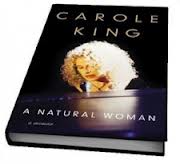
A Natural Woman, by Carole King


Thanksgiving road trip? Looking for a compelling and fun audiobook to pass the time? Here's what your dashboard CD player's been waiting for: Carole King's memoir, "A Natural Woman."

King turned 70 "One Fine Day" this year -- a fact guaranteed to make a boomer like me feel old. Born Carol Klein, a nice Jewish girl from Brooklyn, King's known for the saxy hit "Jazzman," but has led a rock 'n roll life. In "A Natural Woman," a double your fun read/listen, King dishes on her tumultuous, celeb-studded life. Her honeyed, New Yorky voice takes the listener back in time. A key bonus of the audiotape is that she belts out song snippets. Want to revisit the druggy sixties and feminist seventies? King's memoir will not only take you there, but leave you feeling "You've Got a Friend."

As is required in memoir writing, King gives us the dirt -- four marriages, including a first husband who became mentally ill and a later marriage to a charismatic and charming man who would eventually emotionally and physically abuse her. A staunch liberal and environmentalist -- the title "A Natural Woman" couldn't be more fitting -- King spent years raising her kids in a cabin in Idaho. Sprinkle these gems with tales of performing with James Taylor, and of social drama with John Lennon, and you've got a virtual "Tapestry" of juicy listening.

On the downside, King often comes across as opinionated and preachy, and at times I wanted her to stop explaining and just TELL THE STORY! This sometimes detracted from the fun of listening to the drama of her life.


"A Natural Woman" is the perfect book for a road trip. I bet the music of King's life will render rough roads so smooth you'll never think "I Feel the Earth Move." And if you're already on the road, en route to your turkey day destination, you can listen to King's memoir on your winter break trip. "It's [never] Too Late," baby.

Sunday, November 4, 2012

Reading My Father, by Alexandra Styron


One of the history teachers at my kids' high school gives off such a calm and friendly vibe that within minutes of first meeting him, I could tell my kids would be in good hands in his class. I often have the same experience when I meet a new book. My hands flip the cover open, and from the page one, chapter one, I get that vibe. Well-crafted prose shows that the author is deft and trustworthy and that what's to come will be a pleasure.

It didn't take me long to realize that Alexandra Styron's one of these authors.

Ms. Styron, the youngest daughter of Pulitzer Prize winner William Styron (author of "Darkness Visible" and "Sophie's Choice") has penned a daughter's memoir, one that succeeds on many levels. It tells us her story, of growing up in the most privileged pockets of the East Coast. It also takes us deep into the glittery life of her famous and mercurial father, one of the Big Shouldered Authors of the '70s, a contemporary and friend of Norman Mailer and Arthur Miller. And most compellingly, Styron takes us deep into her volatile yet loving relationship with her dad.

Despite being a tad turned off when Ms. Styron recounted stories of the brushes she had as a younger adult with the rich and famous -- a minor complaint I'm more than willing to overlook -- Styron shows us the way memoir should be done, with brazen honesty and unwavering generosity.

If you're a memoir lover, you'll love "Reading My Father." Enjoy.

Saturday, September 15, 2012

Margaret Atwood


I surprised myself at Margaret Atwood's Q&A when I asked her if she's read "Fifty Shades of Grey." Her response: "I don't have to." She explained that books of this type come around periodically. "This is what we call a "shop and f&ck" book. Men also enjoy them, but have trouble with the first part."

Atwood's work is gloomy, but she's funny.

I ended up with an invitation to the dinner that preceded her reading at Butler, and I buzzed with adrenalin. When Atwood, a petite woman in her mid-seventies, entered the room of students and professors, most of us kept at a polite distance. Literary royalty. At a certain point I took a deep breath, sat down in a space next to her that had just been vacated, and found myself making small talk.

With Margaret Atwood.

I asked her if her busy touring schedule interfered with her writing, and she said, "When I travel I'm away from things in my life that interfere with writing." She takes advantage of time spent on planes and in hotel rooms to write, and makes a point of letting her "people" know she doesn't know how to answer her cellphone. (She must be playing with them. Her books have cautionary tales about the dangers of technology, but she doesn't strike me as someone intimidated by it. In fact, she's an active tweeter.) I told her how surprised I was to find that on the audiobook of "The Year of the Flood," the hymns are performed -- with instrumental accompaniment. She told me her agent's partner, Orville, plays with a band, and when he read the manuscript, he took it upon himself to set her lyrics to music. On the recording he and his band performed these pieces.

After the dinner, Atwood spoke at Clowes Hall, and by the way, if you think people aren't reading anymore, you should have seen the crowd. Atwood spoke on the question of whether or not we can we write the future. Her first point: The future doesn't exist, so it's up for grabs. No one can fact check it! She gave us examples of the wild and disparate ways the future has been imagined, from Hollywood's "Men in Black," which she watched on the plane, to Potatomancy, a practice which uses spuds as divining objects. Atwood deadpanned that there could be cults founded by Frito-Lay.

Atwood spoke about how we humans are hard-wired for storytelling, and that language is structured to delineate time.

Both at her talk and at her Q&A, Atwood spoke about her environmental concerns. These issues are engine that drives Atwood's MaddAdam Trilogy. ("Oryx and Crake" and "The Year of the Flood" are the first two installments.) No surprise, Atwood's done her homework. Twice she mentioned that during the Vietnam War we could have easily decimated our planet. The U.S. shipped vast quantities of Agent Orange across the ocean, and if any of those ships had spilled, the blue-green algae, which produce a large percent of our oxygen, would have been destroyed.

But despite these Cassandra-like stories, Atwood's managed to hold on to her sense of humor. And unlike many of the writers who came to Butler last semester, she didn't keep her fans at arm's length-- she was accessible and forthcoming. When she obliged and posed with us for pictures, she exuded a quality I can best describe as regal. She glowed.

Atwood's work is rife with doomsday warnings, but in her lecture she also spoke of hope. She said her wish for us to have hope, and when someone asked her what she wishes we hope for, she answered, "More hope."

Tuesday, September 11, 2012

Orxy and Crake, by Margaret Atwood


Some people have a hard time saying no to chocolate chip cookies. Me? I'll eat those cookies every time, but my willpower really pales when faced with having to choose from the list of Butler's creative writing courses. So much great learning! So little time! This fall, the nonfiction workshop taught by a visiting prof from DePauw was a no-brainer, but there were two other courses, just as delicious. I just couldn't say no. In the spirit of compromise, instead of registering for those two additional courses, I decided to audit. Still, I'm not in this game for the grade. I'm in it to learn, so I've got to put in the work. The semester's still green, and I'm running fast, trying to settle in, and figure out the classes' rhythms.

This morning I sat down to read stories assigned to me by the editors at Booth, the literary magazine at Butler. Reading takes time, especially for a slowpoke like me. (Undiagnosed learning disability? I often wonder.) As I tucked into the first story I thought about all the other reading I needed to do and the muscles in my scalp tightened. Reading for Booth is yet another great way to learn, but it takes so much time. I must admit I haven't had the sunniest attitude about my Booth-reading responsibilities as of late. But get this: If you were to have walked by my spot in the coffee shop when I was halfway through, you'd have seen me grinning. The stories were that good. (And even when a story wasn't Booth-worthy, I knew I'd learned from it. Reading carefully, trying to discern what works and what doesn't, will do that.) Stories can be magical. They can transform, surprise, and teach a whole new way to be in the world, and that's no small thing.

I read Atwood's "Oryx and Crake" for one of the courses I'm auditing. To tell you the truth, I doubt I would have ever picked up Atwood if it wasn't required reading. I like fiction. Sometimes. But most of the time I put more stock in nonfiction. Most of the time, my take is that real life -- so compelling, confusing and confounding -- renders fiction unnecessary. When I picked up "Oryx and Crake," it wasn't long before I was quickly sucked into the story. I'd forgotten the power fiction has to surprise and captivate.

Atwood calls her work "speculative fiction," (as opposed to science fiction), in that she doesn't employ fantastical story elements. No space ships teeming with Martians. Atwood's tales are about the dystopian, future worlds that could come about when a society is overly-stressed. In "Oryx and Crake," Jimmy survives an apocalypse, the earth battered and depleted, his only company a bunch of genetically modified humanoid creatures -- Crakers. The Crakers look to Jimmy as a god, and as Atwood shows us the these strange Crakers, she deftly shifts back and forth, using flashback to tell us how humankind, and Jimmy, came to this perilous and desperate point.

Atwood tells a great story, but there's more. Her stories carry weight. (Psychic weight, if you will, a term I just learned at a Booth meeting.) Atwood's got something to say that's deeper than the storyline. It always fascinates me to discover what captures an author's imagination. Atwood is fascinated at how delicate civilization is, how fast society can disintegrate, and how little it would take for us to give up our freedoms.

There is so much to learn. How lucky are we that Atwood, a Big Question kind of author, will be speaking tomorrow here at Butler. Scan the crowd and look for me -- I'll be the one scribbling notes, listening closely, doing my best to learn, a big grin on my face.

Thursday, August 23, 2012

Bringing up Bebe, by Pamela Druckerman


When Ms. Druckerman moved across the pond with her husband, she was a bride, her heart set on beginning a family. "Bringing Up Bebe" begins here, with Druckerman ambivalently navigating foreign soil and infertility treatments. Luckily, children were in the cards, and it wasn't long before the we see the author, still living Paris, raising two small children.

A journalist, Druckerman couldn't help but notice subtle, yet pervasive, differences between American-style parenting and the way French parents relate to their charges. While the overriding sentiment behind much of American parenting seems to be anxiety, the French--perhaps due, in part, to the availability of subsidized childcare--take a more relaxed approach. Druckerman writes about the Pause, the French way of waiting for a moment or two before responding to a child's cries. Using this simple, common sense technique allows for the possibility of self-regulation by the child. But whether discussing sleeping through the night or dining with children in restaurants, Druckerman purports that the French are better at communicating that they have clear expectations for their children. When teaching them how to behave, the French don't flinch in the face of tantrums. When a child shows his or her unhappiness, the French don't rush to make the child happy, but react with restraint.

A book like this can't help but paint parents on either side of the Atlantic with broad strokes---how else to make its point? Druckerman's stereotypes didn't bother me. After all, I WAS the stereotypical nervous mother. What did become wearying was the extent to which the author paraded her roster of experts, the myriad doctors and caregivers whose proclamations supported her thesis. Still, "Bringing Up Bebe" is a fun, thought provoking read that won't keep you from sleeping through the night.

Monday, August 13, 2012

Let's Pretend This Never Happened, by Jenny Lawson


Very few things make me laugh out loud. My family accuses me of having no sense of humor. That may be true, but I prefer to think of myself as discriminating. Last semester my classmate, Ashley, clued me in on Jenny Lawson, aka The Bloggess. "Susan, you MUST read her blog. And she's coming out with a memoir!" I gave Ashley my head tilt of agreement, and said "Uh-huh," but even as those syllables came out of my mouth, I was thinking Ashley's "super-funny" could very well be my "meh."

And that's why I almost hate to admit this, but today, while I listened to the audiotape of LPTNH, I heard a noise I almost didn't recognize. It took me a second or two for it to sink in. It was me, laughing.

In a cyber-world where it seems as though everyone blogs, Lawson has done something pretty remarkable. She parlayed her achievements as a blogger into a successful vault into the literary zeitgeist. What are the odds?

Lawson grew up in a small town in Texas, the daughter of a taxidermist who often brought his work home. Lawson writes about the strange episodes of her childhood, most of which involve the feral animals -- some alive, some dead -- her father brought into their home. Writing about her adult life, Lawson fesses up to struggling with a disease that left her ability to sustain a pregnancy questionable, a whooping anxiety disorder and rheumatoid arthritis. She manages to transform her tragedy and suffering with humor and a keen eye for ironic detail. No, dead babies are not funny, but Lawson, caught in a situation that would drive anyone mad, holds our hands and takes us to a place where we can laugh at the sheer absurdity of her situation.

Sure, read the book. But if you can, listen to the audiobook, which Lawson reads herself. Her delivery is spot-on, pee-in-your-pants funny. But don't fool yourself into thinking you can get away with listening while your kids are around. Lawson loves profanity, and is particularly fond of tossing out the F-bomb. Occasionally I thought Lawson went a little too far, that the humor, instead of clever, became silly. For instance, at the end of the audiotape she talks about how the word "vagina" is funny, and in this riff she repeats the word at least 25 times. Enough already. But pushing aside a few minor complaints, I think Jenny Lawson is amazing and smart and twisted and really, really funny. LPTNH is witty and tender and profane. And hysterical, just like Ashley said.

P.S. Lawson's success coming on the heels of her blog made me remember an interview with Anne Lamott, one of my all-time fave authors, from a few years back. In this interview, which I think appeared in Salon, she opined that she saw no purpose in blogging, and that she wants to write books. This, despite my undying love and admiration for Lamott, pissed me off. (Sorry, I'm getting all Jenny Lawson-cursey on you, aren't I?) I thought Lamott's remark was myopic, especially for someone who writes heartfelt, underdog memoir. Recently, though, through her Facebook fan page, Lamott has started posting kick-ass mini-essays (there I go again with the cursing), blog-style. Which just goes to show you, don't underestimate the power of words, even if they appear on the screen instead of the page.

Which reminds me, it's about time I reviewed Lamott's new book.

Until then,
Susan