On the Sunday after the holiday, my family was still celebrating Thanksgiving. A half-full pan of leftover turkey sat on the middle shelf in the fridge, and the beds in our basement and spare rooms were still warm from out-of-town relatives, my mother-in-law and cousins. Every year on Thanksgiving, my family dines on a meal featuring a giant roasted bird, marshmallow-topped sweet potato and orange-cranberry-apple relish, but what we really look forward to is gathering with family. Expectations like these can be a recipe for disappointment.
This year, the holiday served as a nudge, a reminder, to keep my expectations in check. To stay flexible. The cousins who always come in from St. Louis had to leave early to attend a friend's wedding. My West Coast father had to cancel his visit when he came down with a bout of arthritis so severe it sent him to the hospital. My mother-in-law made the trip from Cincy, but not until turkey-day-plus-one -- she couldn't find anyone to feed the stray cat she's been giving bowls on tuna to for the past few years.
Since we're talking Thanksgiving, I'll segue into being thankful for books -- which is what I'm supposed to be writing about, anyway. For instance, Rich Cohen's family memoir, "Sweet and Low." Cohen is a grandson of Ben Eisenstadt, the man who invented sugar packets (Am I the only one old enough to remember the sugar crust on the metal-topped glass pourers that sat on tables in diners next to the ketchup and mustard?), and Sweet 'N Low, the artificial sweetener in the little pink packets. This family memoir may not feature early-departing cousins, arthritic fathers, or cat-obsessed mother-in-laws, but Cohen's got his own cast of zany characters. And his journalism background -- he's written for The New Yorker and Vanity Fair -- serves him well. The dialogue in "Sweet and Low" will slay you. His rich uncles are machers and his great-aunts are nuts, which is how it is in all families, right? Cohen shows us a version of the Amercian Dream, a small family business that serendipitously finds a way to fill a need. But things don't stay sweet for long in "Sweet and Low." Scientists uncovered evidence that saccharine may be carcinogenic, there was family infighting, the business developed ties to the mafia, and there were troubles with the government. Cohen gives his family's story context by peppering the text with cultural touchpoints -- the advent of the country's dieting craze, how takeovers took over America's business landscape, and how government regulations serve to protect the public while crippling business.
"Sweet and Low" is a loving look at family, and a nice reminder that even when my kin can't join me for the holiday, there's still plenty to be thankful for.
Tuesday, November 27, 2012
Tuesday, November 20, 2012
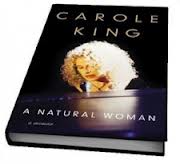
A Natural Woman, by Carole King
Thanksgiving road trip? Looking for a compelling and fun audiobook to pass the time? Here's what your dashboard CD player's been waiting for: Carole King's memoir, "A Natural Woman."
King turned 70 "One Fine Day" this year -- a fact guaranteed to make a boomer like me feel old. Born Carol Klein, a nice Jewish girl from Brooklyn, King's known for the saxy hit "Jazzman," but has led a rock 'n roll life. In "A Natural Woman," a double your fun read/listen, King dishes on her tumultuous, celeb-studded life. Her honeyed, New Yorky voice takes the listener back in time. A key bonus of the audiotape is that she belts out song snippets. Want to revisit the druggy sixties and feminist seventies? King's memoir will not only take you there, but leave you feeling "You've Got a Friend."
As is required in memoir writing, King gives us the dirt -- four marriages, including a first husband who became mentally ill and a later marriage to a charismatic and charming man who would eventually emotionally and physically abuse her. A staunch liberal and environmentalist -- the title "A Natural Woman" couldn't be more fitting -- King spent years raising her kids in a cabin in Idaho. Sprinkle these gems with tales of performing with James Taylor, and of social drama with John Lennon, and you've got a virtual "Tapestry" of juicy listening.
On the downside, King often comes across as opinionated and preachy, and at times I wanted her to stop explaining and just TELL THE STORY! This sometimes detracted from the fun of listening to the drama of her life.
"A Natural Woman" is the perfect book for a road trip. I bet the music of King's life will render rough roads so smooth you'll never think "I Feel the Earth Move." And if you're already on the road, en route to your turkey day destination, you can listen to King's memoir on your winter break trip. "It's [never] Too Late," baby.
Sunday, November 4, 2012
Reading My Father, by Alexandra Styron
One of the history teachers at my kids' high school gives off such a calm and friendly vibe that within minutes of first meeting him, I could tell my kids would be in good hands in his class. I often have the same experience when I meet a new book. My hands flip the cover open, and from the page one, chapter one, I get that vibe. Well-crafted prose shows that the author is deft and trustworthy and that what's to come will be a pleasure.
It didn't take me long to realize that Alexandra Styron's one of these authors.
Ms. Styron, the youngest daughter of Pulitzer Prize winner William Styron (author of "Darkness Visible" and "Sophie's Choice") has penned a daughter's memoir, one that succeeds on many levels. It tells us her story, of growing up in the most privileged pockets of the East Coast. It also takes us deep into the glittery life of her famous and mercurial father, one of the Big Shouldered Authors of the '70s, a contemporary and friend of Norman Mailer and Arthur Miller. And most compellingly, Styron takes us deep into her volatile yet loving relationship with her dad.
Despite being a tad turned off when Ms. Styron recounted stories of the brushes she had as a younger adult with the rich and famous -- a minor complaint I'm more than willing to overlook -- Styron shows us the way memoir should be done, with brazen honesty and unwavering generosity.
If you're a memoir lover, you'll love "Reading My Father." Enjoy.
Saturday, September 15, 2012
Margaret Atwood
I surprised myself at Margaret Atwood's Q&A when I asked her if she's read "Fifty Shades of Grey." Her response: "I don't have to." She explained that books of this type come around periodically. "This is what we call a "shop and f&ck" book. Men also enjoy them, but have trouble with the first part."
Atwood's work is gloomy, but she's funny.
I ended up with an invitation to the dinner that preceded her reading at Butler, and I buzzed with adrenalin. When Atwood, a petite woman in her mid-seventies, entered the room of students and professors, most of us kept at a polite distance. Literary royalty. At a certain point I took a deep breath, sat down in a space next to her that had just been vacated, and found myself making small talk.
With Margaret Atwood.
I asked her if her busy touring schedule interfered with her writing, and she said, "When I travel I'm away from things in my life that interfere with writing." She takes advantage of time spent on planes and in hotel rooms to write, and makes a point of letting her "people" know she doesn't know how to answer her cellphone. (She must be playing with them. Her books have cautionary tales about the dangers of technology, but she doesn't strike me as someone intimidated by it. In fact, she's an active tweeter.) I told her how surprised I was to find that on the audiobook of "The Year of the Flood," the hymns are performed -- with instrumental accompaniment. She told me her agent's partner, Orville, plays with a band, and when he read the manuscript, he took it upon himself to set her lyrics to music. On the recording he and his band performed these pieces.
After the dinner, Atwood spoke at Clowes Hall, and by the way, if you think people aren't reading anymore, you should have seen the crowd. Atwood spoke on the question of whether or not we can we write the future. Her first point: The future doesn't exist, so it's up for grabs. No one can fact check it! She gave us examples of the wild and disparate ways the future has been imagined, from Hollywood's "Men in Black," which she watched on the plane, to Potatomancy, a practice which uses spuds as divining objects. Atwood deadpanned that there could be cults founded by Frito-Lay.
Atwood spoke about how we humans are hard-wired for storytelling, and that language is structured to delineate time.
Both at her talk and at her Q&A, Atwood spoke about her environmental concerns. These issues are engine that drives Atwood's MaddAdam Trilogy. ("Oryx and Crake" and "The Year of the Flood" are the first two installments.) No surprise, Atwood's done her homework. Twice she mentioned that during the Vietnam War we could have easily decimated our planet. The U.S. shipped vast quantities of Agent Orange across the ocean, and if any of those ships had spilled, the blue-green algae, which produce a large percent of our oxygen, would have been destroyed.
But despite these Cassandra-like stories, Atwood's managed to hold on to her sense of humor. And unlike many of the writers who came to Butler last semester, she didn't keep her fans at arm's length-- she was accessible and forthcoming. When she obliged and posed with us for pictures, she exuded a quality I can best describe as regal. She glowed.
Atwood's work is rife with doomsday warnings, but in her lecture she also spoke of hope. She said her wish for us to have hope, and when someone asked her what she wishes we hope for, she answered, "More hope."
Tuesday, September 11, 2012
Orxy and Crake, by Margaret Atwood
Some people have a hard time saying no to chocolate chip cookies. Me? I'll eat those cookies every time, but my willpower really pales when faced with having to choose from the list of Butler's creative writing courses. So much great learning! So little time! This fall, the nonfiction workshop taught by a visiting prof from DePauw was a no-brainer, but there were two other courses, just as delicious. I just couldn't say no. In the spirit of compromise, instead of registering for those two additional courses, I decided to audit. Still, I'm not in this game for the grade. I'm in it to learn, so I've got to put in the work. The semester's still green, and I'm running fast, trying to settle in, and figure out the classes' rhythms.
This morning I sat down to read stories assigned to me by the editors at Booth, the literary magazine at Butler. Reading takes time, especially for a slowpoke like me. (Undiagnosed learning disability? I often wonder.) As I tucked into the first story I thought about all the other reading I needed to do and the muscles in my scalp tightened. Reading for Booth is yet another great way to learn, but it takes so much time. I must admit I haven't had the sunniest attitude about my Booth-reading responsibilities as of late. But get this: If you were to have walked by my spot in the coffee shop when I was halfway through, you'd have seen me grinning. The stories were that good. (And even when a story wasn't Booth-worthy, I knew I'd learned from it. Reading carefully, trying to discern what works and what doesn't, will do that.) Stories can be magical. They can transform, surprise, and teach a whole new way to be in the world, and that's no small thing.
I read Atwood's "Oryx and Crake" for one of the courses I'm auditing. To tell you the truth, I doubt I would have ever picked up Atwood if it wasn't required reading. I like fiction. Sometimes. But most of the time I put more stock in nonfiction. Most of the time, my take is that real life -- so compelling, confusing and confounding -- renders fiction unnecessary. When I picked up "Oryx and Crake," it wasn't long before I was quickly sucked into the story. I'd forgotten the power fiction has to surprise and captivate.
Atwood calls her work "speculative fiction," (as opposed to science fiction), in that she doesn't employ fantastical story elements. No space ships teeming with Martians. Atwood's tales are about the dystopian, future worlds that could come about when a society is overly-stressed. In "Oryx and Crake," Jimmy survives an apocalypse, the earth battered and depleted, his only company a bunch of genetically modified humanoid creatures -- Crakers. The Crakers look to Jimmy as a god, and as Atwood shows us the these strange Crakers, she deftly shifts back and forth, using flashback to tell us how humankind, and Jimmy, came to this perilous and desperate point.
Atwood tells a great story, but there's more. Her stories carry weight. (Psychic weight, if you will, a term I just learned at a Booth meeting.) Atwood's got something to say that's deeper than the storyline. It always fascinates me to discover what captures an author's imagination. Atwood is fascinated at how delicate civilization is, how fast society can disintegrate, and how little it would take for us to give up our freedoms.
There is so much to learn. How lucky are we that Atwood, a Big Question kind of author, will be speaking tomorrow here at Butler. Scan the crowd and look for me -- I'll be the one scribbling notes, listening closely, doing my best to learn, a big grin on my face.
Thursday, August 23, 2012
Bringing up Bebe, by Pamela Druckerman
When Ms. Druckerman moved across the pond with her husband, she was a bride, her heart set on beginning a family. "Bringing Up Bebe" begins here, with Druckerman ambivalently navigating foreign soil and infertility treatments. Luckily, children were in the cards, and it wasn't long before the we see the author, still living Paris, raising two small children.
A journalist, Druckerman couldn't help but notice subtle, yet pervasive, differences between American-style parenting and the way French parents relate to their charges. While the overriding sentiment behind much of American parenting seems to be anxiety, the French--perhaps due, in part, to the availability of subsidized childcare--take a more relaxed approach. Druckerman writes about the Pause, the French way of waiting for a moment or two before responding to a child's cries. Using this simple, common sense technique allows for the possibility of self-regulation by the child. But whether discussing sleeping through the night or dining with children in restaurants, Druckerman purports that the French are better at communicating that they have clear expectations for their children. When teaching them how to behave, the French don't flinch in the face of tantrums. When a child shows his or her unhappiness, the French don't rush to make the child happy, but react with restraint.
A book like this can't help but paint parents on either side of the Atlantic with broad strokes---how else to make its point? Druckerman's stereotypes didn't bother me. After all, I WAS the stereotypical nervous mother. What did become wearying was the extent to which the author paraded her roster of experts, the myriad doctors and caregivers whose proclamations supported her thesis. Still, "Bringing Up Bebe" is a fun, thought provoking read that won't keep you from sleeping through the night.
Monday, August 13, 2012
Let's Pretend This Never Happened, by Jenny Lawson
Very few things make me laugh out loud. My family accuses me of having no sense of humor. That may be true, but I prefer to think of myself as discriminating. Last semester my classmate, Ashley, clued me in on Jenny Lawson, aka The Bloggess. "Susan, you MUST read her blog. And she's coming out with a memoir!" I gave Ashley my head tilt of agreement, and said "Uh-huh," but even as those syllables came out of my mouth, I was thinking Ashley's "super-funny" could very well be my "meh."
And that's why I almost hate to admit this, but today, while I listened to the audiotape of LPTNH, I heard a noise I almost didn't recognize. It took me a second or two for it to sink in. It was me, laughing.
In a cyber-world where it seems as though everyone blogs, Lawson has done something pretty remarkable. She parlayed her achievements as a blogger into a successful vault into the literary zeitgeist. What are the odds?
Lawson grew up in a small town in Texas, the daughter of a taxidermist who often brought his work home. Lawson writes about the strange episodes of her childhood, most of which involve the feral animals -- some alive, some dead -- her father brought into their home. Writing about her adult life, Lawson fesses up to struggling with a disease that left her ability to sustain a pregnancy questionable, a whooping anxiety disorder and rheumatoid arthritis. She manages to transform her tragedy and suffering with humor and a keen eye for ironic detail. No, dead babies are not funny, but Lawson, caught in a situation that would drive anyone mad, holds our hands and takes us to a place where we can laugh at the sheer absurdity of her situation.
Sure, read the book. But if you can, listen to the audiobook, which Lawson reads herself. Her delivery is spot-on, pee-in-your-pants funny. But don't fool yourself into thinking you can get away with listening while your kids are around. Lawson loves profanity, and is particularly fond of tossing out the F-bomb. Occasionally I thought Lawson went a little too far, that the humor, instead of clever, became silly. For instance, at the end of the audiotape she talks about how the word "vagina" is funny, and in this riff she repeats the word at least 25 times. Enough already. But pushing aside a few minor complaints, I think Jenny Lawson is amazing and smart and twisted and really, really funny. LPTNH is witty and tender and profane. And hysterical, just like Ashley said.
P.S. Lawson's success coming on the heels of her blog made me remember an interview with Anne Lamott, one of my all-time fave authors, from a few years back. In this interview, which I think appeared in Salon, she opined that she saw no purpose in blogging, and that she wants to write books. This, despite my undying love and admiration for Lamott, pissed me off. (Sorry, I'm getting all Jenny Lawson-cursey on you, aren't I?) I thought Lamott's remark was myopic, especially for someone who writes heartfelt, underdog memoir. Recently, though, through her Facebook fan page, Lamott has started posting kick-ass mini-essays (there I go again with the cursing), blog-style. Which just goes to show you, don't underestimate the power of words, even if they appear on the screen instead of the page.
Which reminds me, it's about time I reviewed Lamott's new book.
Until then,
Susan
Subscribe to:
Posts (Atom)